The following is general information introducing research findings. Results reported in studies do not mean the same outcome for any individual, and most of these studies are small or early-stage.
Summary — Parkinson's disease is among the conditions where research into 'replacing lost cells' with stem cells is most advanced. Kyoto University's Center for iPS Cell Research and Application (CiRA) and Kyoto University Hospital transplanted dopamine neurons made from human iPS cells into a monkey model and confirmed engraftment and function (2017), and published results of the resulting phase I/II clinical trial in Nature in 2025. Results of a phase I trial of ES cell-derived cells in the United States and elsewhere were published the same year.
What is Parkinson's disease?
Parkinson's disease is a progressive neurological disease caused by the gradual loss of dopamine-producing neurons in a deep part of the brain called the substantia nigra. Dopamine is needed for smooth control of movement, so its loss causes tremor at rest, slowness of movement, muscle rigidity and postural instability. Non-motor symptoms such as reduced sense of smell, constipation, sleep disturbance and low mood are also common.
It usually begins after the age of 60, and the number of people affected rises with age. In most cases no clear cause is found; some cases are linked to genetic variants. By the time symptoms appear, a considerable proportion of dopamine neurons is thought to have already been lost.
Current standard treatment
Treatment centres on medicines that replace dopamine or support its action. Levodopa and dopamine agonists greatly improve symptoms early on, but as the disease progresses the effect of each dose often wears off sooner and unwanted movements (dyskinesia) appear. When medication becomes hard to manage, deep brain stimulation, which places electrodes in the brain, or continuous infusion therapies are used. These treatments control symptoms but do not restore lost dopamine neurons.
The stem cell approach: replacing lost cells
Because the type of cell lost is relatively clear, Parkinson's disease has long been studied as a target for cell replacement. In the 1980s and 1990s, transplantation of fetal brain tissue was studied and benefits were reported in some patients, but ethical and practical problems in obtaining tissue and variable results remained. When Professor Shinya Yamanaka's team at Kyoto University first reported iPS cells (induced pluripotent stem cells) in 2006, a path opened to producing quality-controlled dopamine neurons in large numbers.
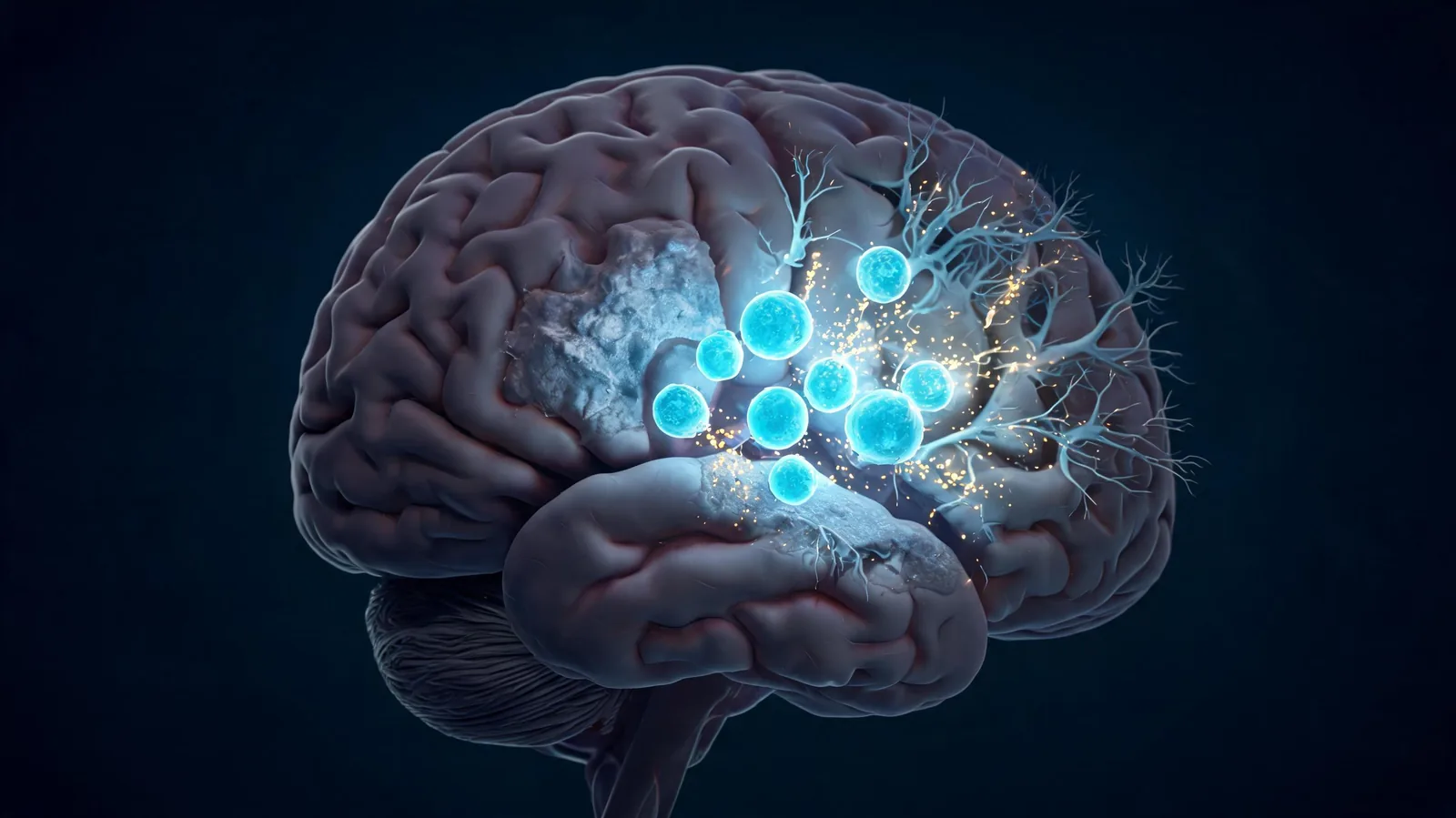
The current approach differentiates iPS cells or ES cells (embryonic stem cells) into cells just before they become dopamine neurons (progenitors) and surgically transplants them directly into the striatum, the part of the brain where dopamine acts. This is fundamentally different from stem cell research in other diseases that gives cells intravenously in the hope of indirect effects.
Reported research findings
① Primate model study (Kyoto University, 2017) — the team transplanted dopamine neuron progenitors made from human iPS cells into the brains of monkeys with a Parkinson's model. The transplanted cells matured into dopamine neurons and engrafted, the monkeys' motor symptoms improved, and no tumours formed during the observation period. The study was published in Nature and provided the basis for human trials.
② iPS cell-derived phase I/II clinical trial (Kyoto University Hospital, published 2025) — seven patients with Parkinson's disease received dopamine neuron progenitors made from donor iPS cells in both sides of the brain and were followed for two years. The main aim was safety, and the trial was reported to have proceeded without serious adverse events or tumour formation. Positron emission tomography (PET) showed increased markers of dopamine production at the graft sites, confirming that the transplanted cells were functioning, and improvement in motor symptom scores off medication was reported in some of the patients who could be evaluated.
③ ES cell-derived phase I clinical trial (United States and Canada, published 2025) — 12 patients received ES cell-derived dopamine neuron progenitors at two dose levels; over 18 months, graft survival was confirmed on imaging without major safety problems.
What has been reported about safety
Risks assessed closely in these studies include surgical risks, side effects of immunosuppressants used to protect the grafted cells, the possibility of unwanted cells proliferating to form tumours, and dyskinesia that may appear after transplantation. Both trials reported that serious problems were uncommon during follow-up, but with few patients and limited follow-up, long-term safety must continue to be monitored.
Open questions
These studies are still small, early clinical trials, and larger controlled studies are needed to confirm efficacy. Determining suitable patients, the number of cells to transplant and the duration of immunosuppression are further tasks. The ISSCR guidelines require especially rigorous stepwise verification for the clinical use of cells derived from pluripotent stem cells.
How results are measured in Parkinson's research
The most widely used tool is the Movement Disorder Society Unified Parkinson's Disease Rating Scale (MDS-UPDRS). Part III is a motor examination in which a physician scores tremor, rigidity, speed of movement, gait and posture. It is assessed in the 'off' state, when medication has worn off, and the 'on' state; in cell transplantation studies, changes in the off-state score are emphasised to reduce the influence of medication. Patients' diaries of daily on and off time are also assessed.
Whether transplanted cells are actually producing dopamine is checked with imaging such as 18F-DOPA PET. In the Kyoto University trial, this test confirmed increased markers of dopamine synthesis at the graft sites.
The above summarises results reported in published papers and public-agency materials. University and institute names are given to identify research sources, not to introduce or recommend any medical institution. Reported results do not mean the same effect for everyone, and the suitability of any treatment is decided by the medical team.
Brain Disorders (Stroke, Parkinson's, Dementia, ALS, MS) →
References
- Takahashi K, Yamanaka S. Induction of pluripotent stem cells from mouse embryonic and adult fibroblast cultures by defined factors. Cell. 2006;126(4):663-676. View on PubMed
- Kikuchi T, Morizane A, Doi D, et al. Human iPS cell-derived dopaminergic neurons function in a primate model of Parkinson's disease. Nature. 2017;548(7669):592-596. View on PubMed
- Sawamoto N, Doi D, Nakanishi E, et al. Phase I/II trial of iPS-cell-derived dopaminergic cells for Parkinson's disease. Nature. 2025. View on PubMed
- Tabar V, Sarva H, Lozano AM, et al. Phase I trial of hES cell-derived dopaminergic neurons for Parkinson's disease. Nature. 2025. View on PubMed
- International Society for Stem Cell Research (ISSCR). Guidelines for Stem Cell Research and Clinical Translation (2021). https://www.isscr.org/guidelines
FTH Co., Ltd. (FTH) is not a medical institution. We provide overseas medical information guidance and translation and interpretation support for medical materials, and does not provide medical consultation, diagnosis, treatment or medical judgements.