The following is general information introducing research findings. Results reported in studies do not mean the same outcome for any individual, and most of these studies are small or early-stage.
Summary — A knee meniscus stem cell therapy has been approved as a regulated product in Japan. On May 8, 2026, FUJIFILM Toyama Chemical, part of the FUJIFILM group, announced marketing approval for SAVYSCUS Injection (Japanese name セイビスカス注), a product made from mesenchymal stem cells taken from the patient's own knee synovium. It is the first regenerative medical product in Japan for meniscus injury. In the phase 3 trial, knee function scores rose sharply and stayed high for two years. In July, Tokai University Hospital also began a clinical study using amnion-derived stem cells for knee osteoarthritis. This article walks through both developments.
The meniscus is the knee's cushion
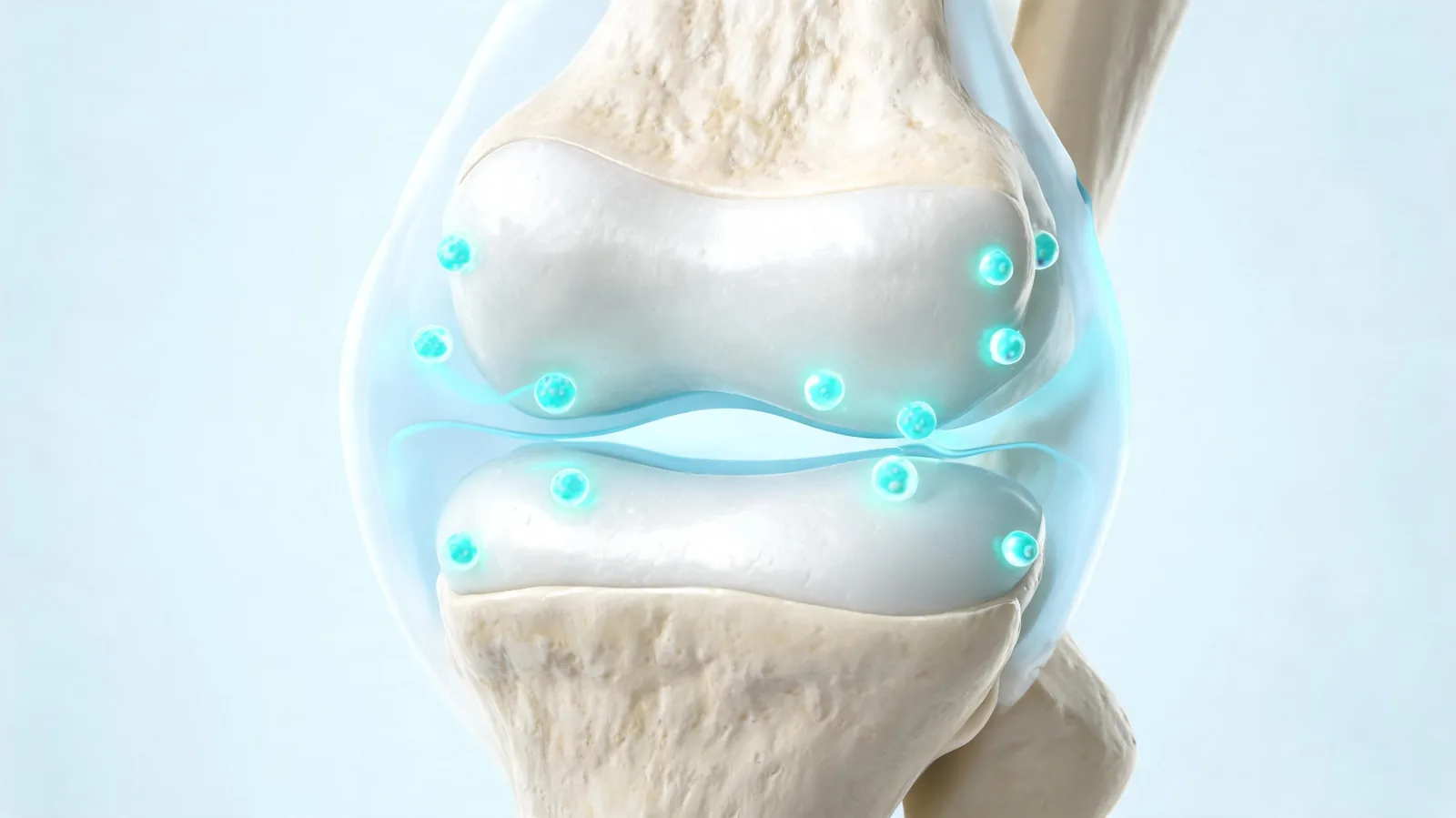
The meniscus is a crescent-shaped piece of fibrocartilage between the thigh bone and the shin bone. It absorbs shock when we walk or run, spreads body weight evenly, and keeps the knee stable. Its inner part has almost no blood supply, so once it tears it rarely heals on its own.
According to FUJIFILM, about 50,000 meniscus operations are performed in Japan each year, and roughly half of them are meniscectomies that cut away the torn part. Among people in their 40s and older the share rises to about 60%. Removing meniscus tissue puts more load on the cartilage and is known to raise the risk of knee osteoarthritis later. That is why researchers have long looked for ways to repair and keep the meniscus. For an overview of stem cell research in the knee, see our knee joint stem cell research page.
What is SAVYSCUS, the knee meniscus stem cell product?
The name comes from "Save the Meniscus." Its generic name is human (autologous) synovium-derived mesenchymal stem cells. The synovium is the thin membrane lining the inside of the joint, and mesenchymal stem cells (MSCs) from this tissue are known for a strong ability to become cartilage cells.
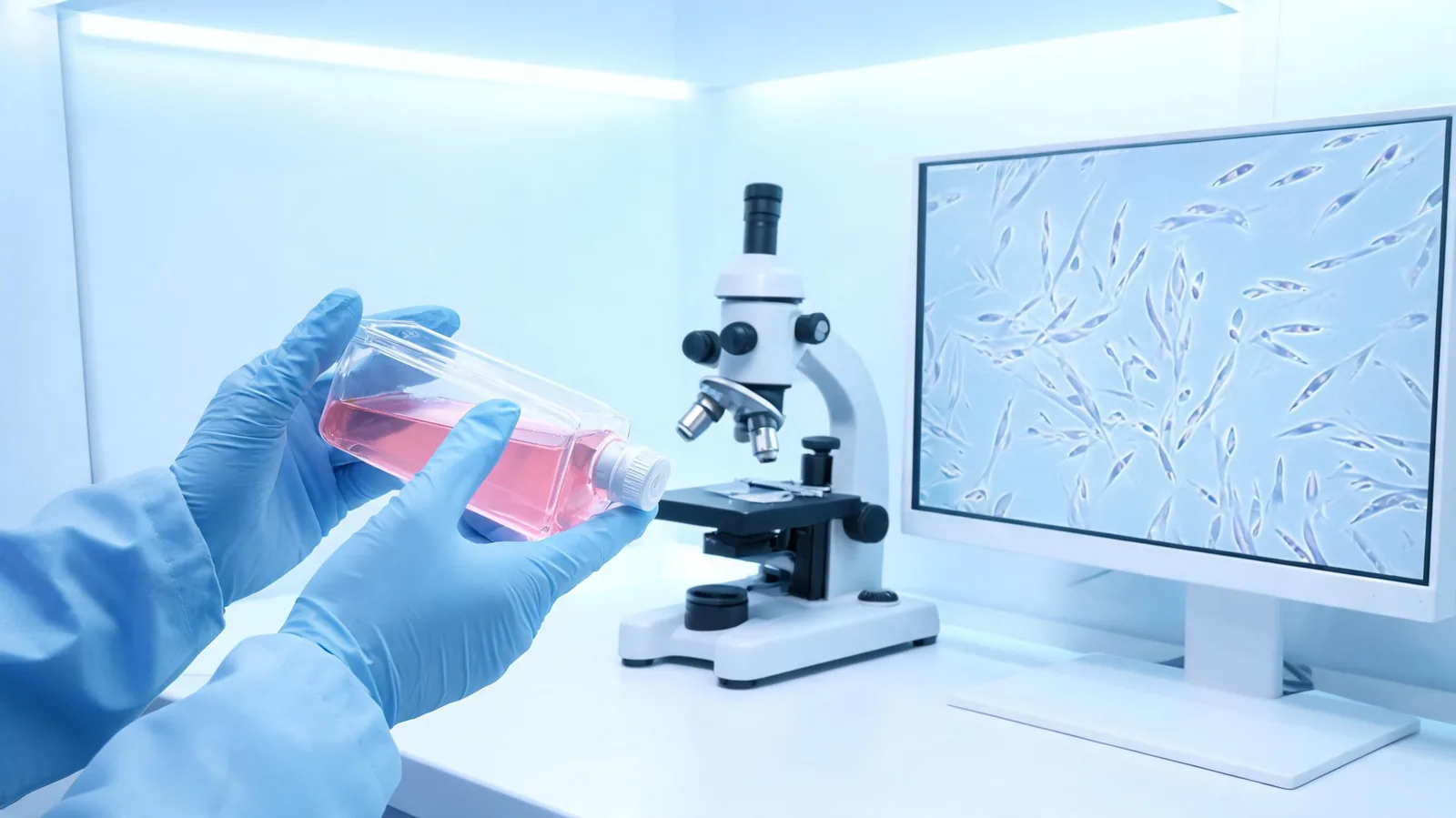
The procedure uses arthroscopy through small incisions. A small piece of synovial tissue is first taken from the patient's knee and cultured to expand the stem cells. Then, during surgery to suture and repair the torn meniscus, the cell suspension is placed at the injured site. The company explains that the cells attach to the injury, differentiate into cartilage cells, produce cartilage matrix, and draw nearby synovial tissue to the site to support repair. Because the patient's own cells are used, the risk of immune rejection is low.
The product is intended for meniscus injuries judged to need meniscectomy that have not improved after 12 weeks of conservative treatment. The main focus is complex, hard-to-repair damage such as flap tears, where part of the meniscus is torn and folded over.
Knee function improved in the phase 3 trial
Approval was based on a phase 3 trial (JP301) that started in Japan in January 2023. It was a single-arm study at four medical institutions, and 19 patients received the cells. Review documents from Japan's Pharmaceuticals and Medical Devices Agency (PMDA) note that this design was accepted because blinding and a control group are hard to set up for this kind of surgery.
The primary endpoint was the Lysholm score, a 100-point measure of knee pain and function. In the 15 patients with confirmed flap tears, the mean score rose from 38.1 at screening to 91.6 at 52 weeks. The change was 53.5 points (95% CI 48.7–58.2), well above the prespecified threshold of 22 points. At 104 weeks the change was 57.8 points (54.4–61.2), showing that the improvement lasted two years. Pain scores (NRS) and every KOOS subscale also tended to improve through week 52.
Structural repair was also seen. On arthroscopic review by independent experts, the central part of the meniscus, which lacks blood vessels and seldom heals naturally, had fully united in 5 of 14 patients (35.7%) at 52 weeks. On MRI, the meniscus improved in 14 of 19 patients (73.7%). No patient needed another operation because of a re-tear through 104 weeks.
Before this, an investigator-led phase 2 trial by Professor Ichiro Sekiya's team at Institute of Science Tokyo (formerly Tokyo Medical and Dental University) raised the Lysholm score of 9 patients from 50.2 to 91.2 at 52 weeks. Professor Sekiya has studied synovial stem cells since 2005 and carried the work from basic research to the clinic with support from the Japan Agency for Medical Research and Development (AMED).
Safety and approval conditions
In the phase 3 trial, no adverse reactions were judged to be related to the cells. Two serious events during the study, including a femoral fracture, were assessed as unrelated to the product. In the phase 2 trial, one case of reduced sensation was recorded as possibly related.
This is a standard approval, not a conditional and time-limited one, with an eight-year re-examination period. The company will survey every treated patient until enough data are collected, and under proper-use guidelines prepared with the relevant academic societies, the product is to be used by doctors experienced in meniscus treatment at suitably equipped facilities. Institute of Science Tokyo says it will build long-term evidence through post-marketing surveillance and work to expand the indications. Japan's approval system for regenerative products is covered in our article on Japan's regenerative medicine system.
Knee stem cell research is expanding to osteoarthritis
On July 10, 2026, Tokai University Hospital announced that a clinical study using human amnion-derived mesenchymal stem cells for knee osteoarthritis had begun on June 23. The amnion is the membrane around the fetus that is normally discarded after birth; in this study the stem cells obtained from it are injected into the knee joint. Led by orthopedic professor Masato Sato, the study will enroll 12 patients aged 20 or older: first 6 patients will receive 10 million cells, then another 6 will receive 50 million cells, to assess safety and effectiveness. The cells are manufactured at a cell processing facility of the company Kaneka.
According to Tokai University, about 10 million people in Japan have symptomatic knee osteoarthritis, with about 30 million potential patients. The hospital has also worked on cartilage regeneration using chondrocyte cell sheets. Japanese knee stem cell research is broadening from meniscus injury to osteoarthritis. Earlier Japanese knee research is described in our article on spinal cord and knee stem cell research in Japan.
Frequently asked questions
Is knee meniscus stem cell therapy just an injection?
With SAVYSCUS, a small amount of synovium is taken arthroscopically and cultured, and the cells are then delivered during surgery that sutures the torn meniscus. Surgery and cell delivery form one procedure.
Where do synovial stem cells come from?
They come from the synovium lining the inside of the patient's own knee joint. Because the patient's own cells are cultured rather than donor cells, the risk of immune rejection is relatively low.
Can this product be used for knee osteoarthritis?
SAVYSCUS is approved for meniscus injuries that would otherwise need meniscectomy. For knee osteoarthritis, separate clinical studies are under way, such as Tokai University's study of amnion-derived stem cells.
Summary
Knee meniscus stem cell therapy has moved beyond the research stage in Japan to become an approved product. In the phase 3 trial, knee function scores stayed high for two years and no patient needed reoperation for a re-tear. It offers a new option to preserve a meniscus that would once have been cut away. New studies in osteoarthritis are also under way. Whether a treatment is suitable, and its risks, are judged by the treating medical team based on the injury and the patient's overall health.
Spinal Cord Injury & Knee Joints →
References
- FUJIFILM Corporation. 国内初、半月板損傷を対象とした再生医療等製品「セイビスカス®注」製造販売承認を取得. 2026-05-08. https://www.fujifilm.com/jp/ja/news/list/13571
- FUJIFILM Corporation. Fujifilm Announces Approval of SAVYSCUS® Injection in Japan. 2026-05. https://www.fujifilm.com/jp/en/news/hq/13571
- PMDA. 審議結果報告書・審査報告書 セイビスカス注(ヒト(自己)滑膜由来間葉系幹細胞). 2026-04-20 (再生医療等製品・生物由来技術部会). https://www.pmda.go.jp/regenerative_medicines/2026/R20260626001/400022000_30800FZX00005_A100_1.pdf
- AMED・富士フイルム富山化学・東京科学大学. 患者自身の滑膜組織由来の幹細胞を用いた再生医療 国内初の半月板損傷を対象とした再生医療等製品「セイビスカス®注」製造販売承認を取得. 2026-05-08. https://www.amed.go.jp/news/seika/files/000159831.pdf
- 東京科学大学. 東京科学大学発の半月板再生医療技術が実用化へ. 2026-05-14. https://www.isct.ac.jp/ja/news/fkzircaip3z3
- 東海大学医学部付属病院. 「ヒト羊膜由来間葉系幹細胞」を用いた変形性膝関節症再生医療の臨床研究を開始しました. 2026-07-10. https://www.u-tokai.ac.jp/ud-medicine/news/18239/
FTH Co., Ltd. (FTH) is not a medical institution. We provide overseas medical information guidance and translation and interpretation support for medical materials, and does not provide medical consultation, diagnosis, treatment or medical judgements.