The following is general information introducing research findings. Results reported in studies do not mean the same outcome for any individual, and most of these studies are small or early-stage.
Summary — In knee osteoarthritis, studies injecting mesenchymal stem cells directly into the joint have been carried out in several countries. A Korean phase I/II study (2014, 18 patients) reported improved pain and function scores in the high-dose group and changes in cartilage measures on MRI and arthroscopy. In Japan, joint treatment using mesenchymal stem cells is classified as Class II regenerative medicine under the regenerative medicine act and is provided by medical institutions after committee review and submission to the Ministry of Health, Labour and Welfare. Japan also approved an autologous cultured cartilage product for cartilage defects in 2012.
What is knee osteoarthritis?
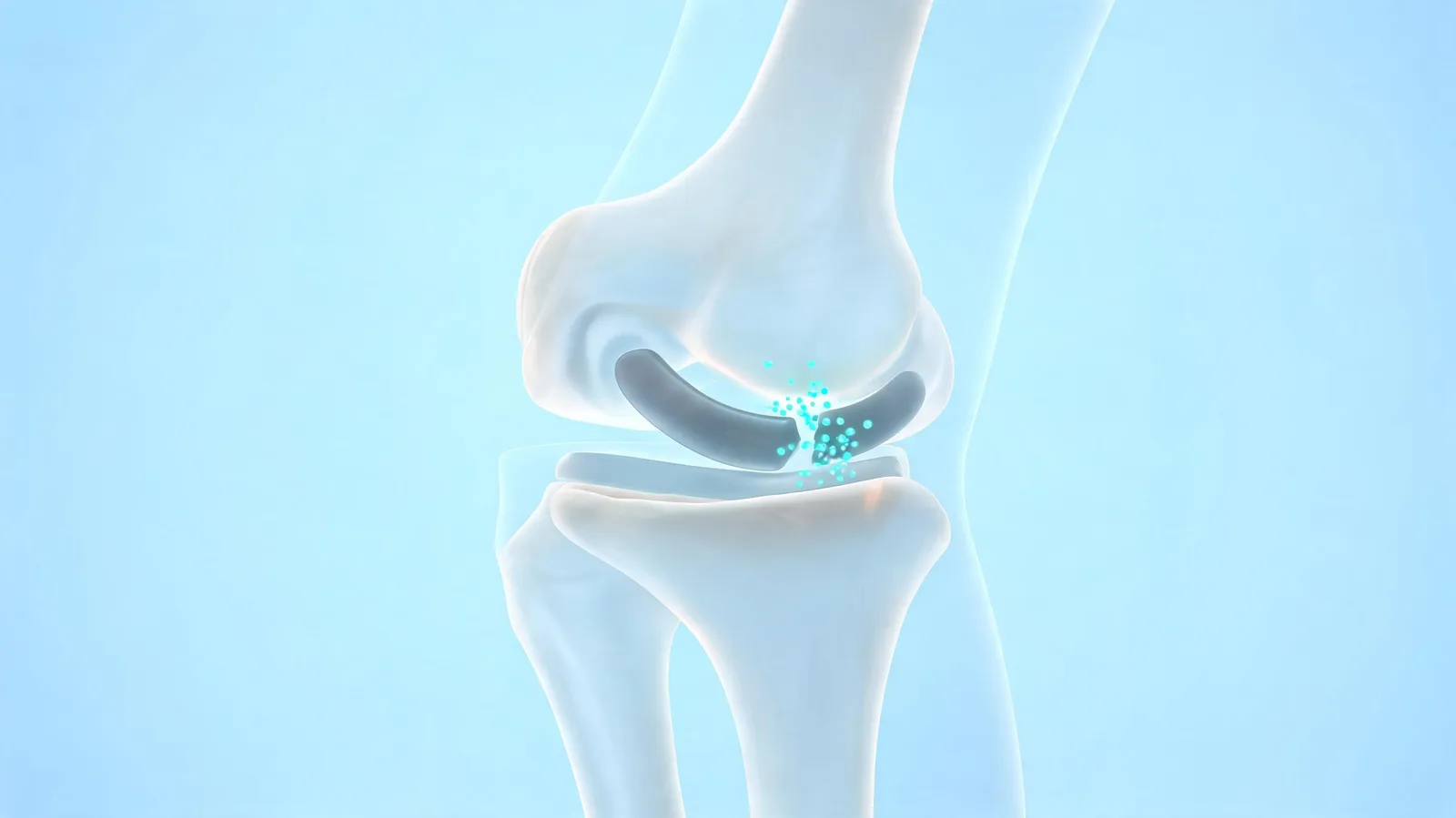
Knee osteoarthritis is a condition in which the cartilage covering the ends of the knee bones wears down and changes occur throughout the joint — in the underlying bone, joint lining and ligaments — causing pain, swelling, stiffness and limited movement. It becomes more likely with age, higher body weight and previous knee injury, and is more common in women. Pain worsens on stairs or after long walks, and as it progresses the legs may bow outward.
Joint cartilage has no blood vessels, so once damaged its ability to repair itself is very limited. This is why cell therapy has long been studied as a way to restore cartilage.
Current standard treatment
Early on, conservative treatment is central: weight management, exercise to strengthen the thigh muscles, pain-relieving anti-inflammatory medicines and braces. If pain persists, steroid or hyaluronic acid injections are used, and in younger patients with localised cartilage damage, arthroscopic surgery or cartilage repair procedures may be considered. When deformity makes daily life difficult, joint replacement is an established treatment. Stem cell injection research aims to test whether pain and function can be improved, and progression slowed, before surgery becomes necessary.
Why stem cells are studied
At first there were high hopes that injected mesenchymal stem cells would become cartilage cells and fill worn cartilage. Later research suggested, however, that injected cells rarely remain in the joint long enough to become cartilage, and many researchers now emphasise indirect actions: factors secreted by the cells reduce inflammation in the joint, protect cartilage cells and support a healing environment.
Cells used and how they were given
Knee studies mainly use mesenchymal stem cells from the patient's own fat tissue or bone marrow, and some use donor cord blood or cord tissue-derived cells. Fat tissue has the advantage that many cells can be obtained by relatively simple liposuction. Methods vary — cells may be expanded in culture before injection, or a cell fraction may be separated and injected without culture — and these differences can affect results.
Reported research findings
Phase I/II intra-articular injection of adipose-derived mesenchymal stem cells (2014) — a Korean team gave 18 patients with knee osteoarthritis a single injection into the knee of mesenchymal stem cells grown from their own fat, at low, medium or high doses. At six months, knee function and pain scores improved in the high-dose group, MRI showed a reduction in the size of cartilage defects, and arthroscopy and tissue examination also showed findings related to cartilage regeneration. No serious adverse events were reported during the study. Published in Stem Cells, the study informed later study designs by showing dose-related differences, but it was a small proof-of-concept study without a control group.
Related area: degenerative disc back pain (2021) — a randomised study injecting allogeneic mesenchymal precursor cells into the discs of patients with chronic low back pain from disc degeneration, compared with placebo, reported 36-month results, with reductions in pain reported in some subgroups and time points.
How it is provided in Japan
In Japan, joint treatment using mesenchymal stem cells falls under 'Class II regenerative medicine' in the regenerative medicine act. A medical institution wishing to provide it must prepare a provision plan, have it reviewed by a certified special committee and submit it to the Ministry of Health, Labour and Welfare; it is often provided as self-pay care not covered by insurance at institutions that have completed this procedure. This means the legal procedure has been followed; it does not mean the state has recognised the treatment as effective. Separately, in 2012 Japan approved as a regenerative medical product an autologous cultured cartilage product, in which the patient's own cartilage cells are cultured and implanted, for conditions such as traumatic cartilage defects.
Open questions
Knee pain shows large placebo effects and fluctuates over time, so randomised studies with control groups are especially important. Long-term studies are needed to determine which stage of osteoarthritis, which cell source and what dose to use, and how long any effect lasts.
How results are measured in knee research
Knee osteoarthritis studies assess pain and function with questionnaires completed by patients. The best known are the WOMAC index, covering pain, stiffness and daily function, and the KOOS score, which adds sport and recreation and quality of life. Pain itself is rated on a 0–10 numerical or visual analogue scale. Treatment effects are judged by whether these scores improve by more than the smallest change patients can feel.
Structural changes in cartilage are assessed by measuring cartilage thickness and defect size on MRI, or by directly observing the cartilage surface arthroscopically and grading it using the International Cartilage Repair Society (ICRS) system. The 2014 study also included tissue examination alongside MRI and arthroscopy. Improvements in pain and function do not always match structural recovery of cartilage, so assessing both is important.
The above summarises results reported in published papers and public-agency materials. University and institute names are given to identify research sources, not to introduce or recommend any medical institution. Reported results do not mean the same effect for everyone, and the suitability of any treatment is decided by the medical team.
Spinal Cord Injury & Knee Joints →
References
- Jo CH, Lee YG, Shin WH, et al. Intra-articular injection of mesenchymal stem cells for the treatment of osteoarthritis of the knee: a proof-of-concept clinical trial. Stem Cells. 2014;32(5):1254-1266. View on PubMed
- Amirdelfan K, Bae H, McJunkin T, et al. Allogeneic mesenchymal precursor cells treatment for chronic low back pain associated with degenerative disc disease: a prospective randomized, placebo-controlled 36-month study of safety and efficacy. Spine J. 2021;21(2):212-230. View on PubMed
- 再生医療等の安全性の確保等に関する法律(平成25年法律第85号)— e-Gov 法令検索 https://laws.e-gov.go.jp/law/425AC0000000085
- 厚生労働省「再生医療について」 https://www.mhlw.go.jp/stf/seisakunitsuite/bunya/kenkou_iryou/iryou/saisei_iryou/index.html
FTH Co., Ltd. (FTH) is not a medical institution. We provide overseas medical information guidance and translation and interpretation support for medical materials, and does not provide medical consultation, diagnosis, treatment or medical judgements.