The following is general information introducing research findings. Results reported in studies do not mean the same outcome for any individual, and most of these studies are small or early-stage.
Summary — Spinal cord injury is a leading example of a field in which a stem cell regenerative medical product has actually been approved in Japan. Based on research at Sapporo Medical University, a product in which mesenchymal stem cells from the patient's own bone marrow are expanded in the patient's serum and given intravenously received conditional, time-limited approval from Japan's Ministry of Health, Labour and Welfare in December 2018. In 2021 the team reported changes in motor and sensory function scores after administration in a case series of 13 patients. At the same time, researchers raised concerns about the level of evidence at the time of approval.
What is spinal cord injury?
The spinal cord is the nerve pathway that carries motor commands and sensory information between the brain and body. When the spine is injured — in a traffic accident, fall or sports accident — and the cord is damaged, paralysis, loss of sensation, bladder and bowel dysfunction, and problems regulating blood pressure and body temperature can occur below the level of injury. Injury in the neck (cervical cord) affects both arms and legs, while injury lower in the chest or back mainly affects the legs.
Injuries are classed as 'complete', with no function remaining below the injury, or 'incomplete', with some function remaining, and are graded internationally on the ASIA Impairment Scale (A–E). After the primary injury, a secondary injury involving inflammation, swelling and cell death develops over hours to weeks and can widen the damage. Reducing this secondary injury is an important goal of treatment research.
Current standard treatment
Immediately after injury, emergency care includes stabilising the spine, surgery to remove bone or disc compressing the cord, and management of blood pressure and breathing. Long-term rehabilitation is then central to recovery of function and adaptation to daily life. Considerable recovery can occur after incomplete injury, but major neurological recovery after complete injury is rare. Because no treatment that directly repairs the injured cord has been established, a range of regenerative medicine research, including cell therapy, is under way.
Why stem cells are studied
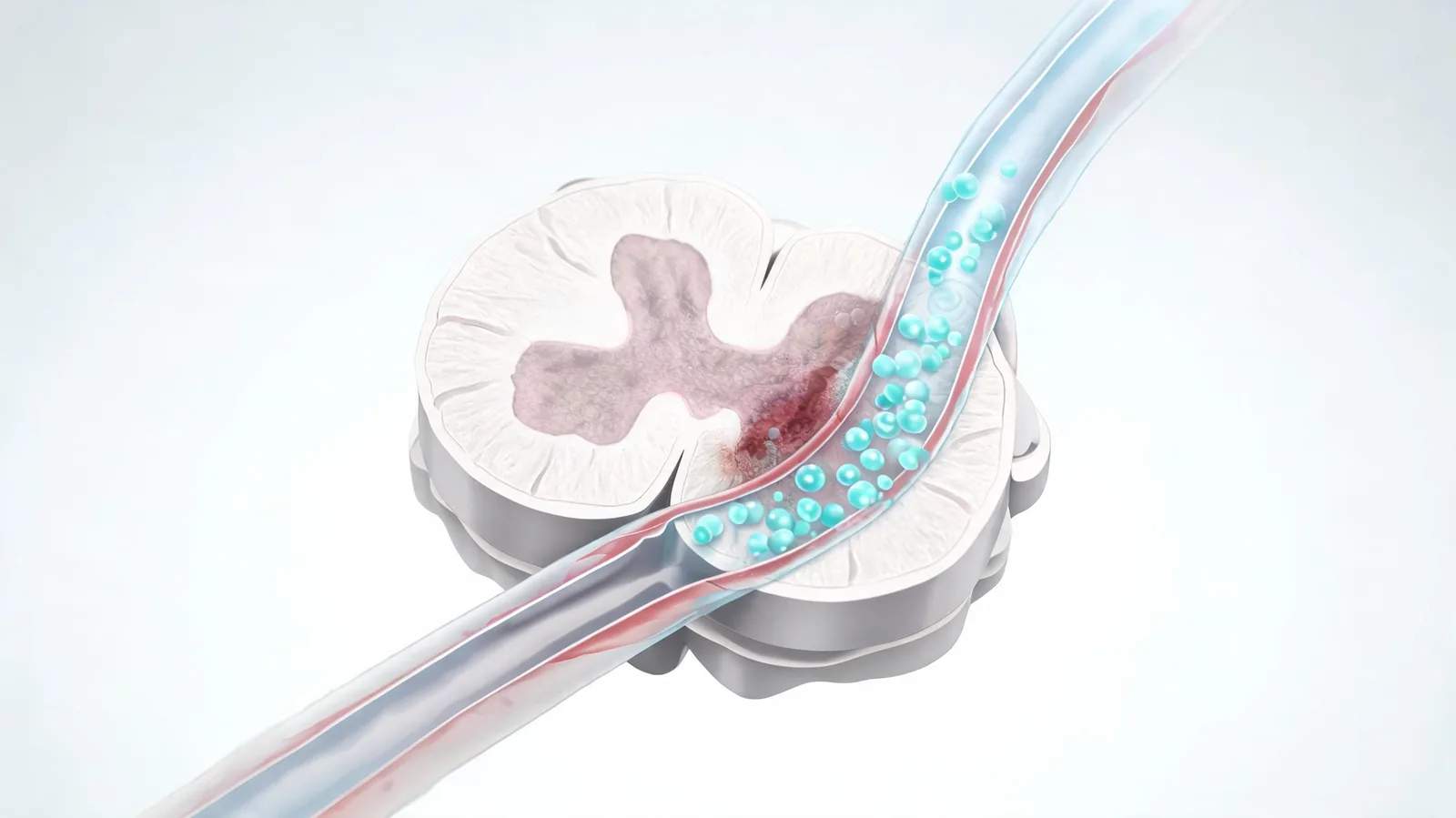
One hypothesis is that giving mesenchymal stem cells intravenously relatively early after injury allows factors they secrete to reduce inflammation and swelling at the injury site, stabilise the blood–spinal cord barrier and protect surviving nerves, limiting secondary injury. They may also support an environment in which nerve fibres regrow or form new connections. The Sapporo Medical University team has reported in animal studies that intravenously given mesenchymal stem cells gathered at the injured cord and supported recovery of motor function.
Reported research findings
Sapporo Medical University's technology — the team developed a method of culturing mesenchymal stem cells using the patient's own serum instead of the bovine serum used in conventional culture. This reduces the risk of infection or immune reactions from animal-derived components and yields enough cells in a short time. The same technology had earlier been used in a study of 12 stroke patients (2011).
Spinal cord injury case series (2021) — the team reported on 13 patients with spinal cord injury, relatively early after injury, who received a single intravenous infusion of cells cultured this way. Improvements were reported after infusion on the ASIA Impairment Scale, motor and sensory scores and assessments of daily activities, and no serious infusion-related adverse events were reported.
Japan's conditional, time-limited approval (2018)
In December 2018 a product based on this technology received conditional, time-limited approval from Japan's Ministry of Health, Labour and Welfare to improve neurological symptoms and functional impairment caused by spinal cord injury. This pathway, created under the Pharmaceuticals and Medical Devices Act for regenerative medical products, allows marketing once safety is confirmed and efficacy is 'presumed', but requires data confirming efficacy within a set period; if efficacy is not confirmed in time, approval may not be maintained. The product is to be used in medical institutions meeting set conditions, for patients who meet eligibility criteria.
Concerns raised and what they mean
A 2019 news article in Nature reported scientists' concerns that the evidence for approval was a small, uncontrolled dataset. Because spontaneous recovery can occur in the first months after spinal cord injury, especially incomplete injury, it is hard to separate the effect of cell administration without a control group — this was the central issue. For this reason, the data accumulated during the conditional approval period are considered important in judging the product's efficacy.
Other research directions
In Japan, clinical research transplanting neural progenitor cells made from iPS cells into patients with subacute spinal cord injury has also been carried out, centred on a team at Keio University. Spinal cord injury is thus a field where quite different approaches — intravenous mesenchymal stem cells and transplantation of pluripotent stem cell-derived cells — are being studied side by side.
How results are measured in spinal cord injury research
The severity of spinal cord injury is assessed with the international ASIA Impairment Scale: A is complete injury with no motor or sensory function below the injury; B, some sensation only; C and D, some motor function (more in D); and E, normal function. Motor scores, rating the strength of 10 key muscle pairs in the arms and legs (maximum 100), and sensory scores for light touch and pinprick across the body are also used.
Real-world function in daily life is assessed with tools such as the Spinal Cord Independence Measure (SCIM). An important point in spinal cord injury research is that, especially after incomplete injury, the ASIA grade often improves by one or more levels naturally in the first months. Judging the effect of cell therapy therefore requires comparison with natural recovery in patients of the same grade at the same stage.
The above summarises results reported in published papers and public-agency materials. University and institute names are given to identify research sources, not to introduce or recommend any medical institution. Reported results do not mean the same effect for everyone, and the suitability of any treatment is decided by the medical team.
Spinal Cord Injury & Knee Joints →
References
- Honmou O, Yamashita T, Morita T, et al. Intravenous infusion of auto serum-expanded autologous mesenchymal stem cells in spinal cord injury patients: 13 case series. Clin Neurol Neurosurg. 2021;203:106565. View on PubMed
- Cyranoski D. Japan's approval of stem-cell treatment for spinal-cord injury concerns scientists. Nature. 2019;565(7741):544-545. View on PubMed
- Honmou O, Houkin K, Matsunaga T, et al. Intravenous administration of auto serum-expanded autologous mesenchymal stem cells in stroke. Brain. 2011;134(Pt 6):1790-1807. View on PubMed
- 再生医療等の安全性の確保等に関する法律(平成25年法律第85号)— e-Gov 法令検索 https://laws.e-gov.go.jp/law/425AC0000000085
FTH Co., Ltd. (FTH) is not a medical institution. We provide overseas medical information guidance and translation and interpretation support for medical materials, and does not provide medical consultation, diagnosis, treatment or medical judgements.