The following is general information introducing research findings. Results reported in studies do not mean the same outcome for any individual, and most of these studies are small or early-stage.
Summary — Stem cell research in chronic pain has mainly targeted chronic low back pain from disc degeneration and knee osteoarthritis pain. A randomised study of 100 patients with degenerative disc back pain, comparing allogeneic mesenchymal precursor cells injected into the disc with control groups, reported 36-month results (2021), with improvements in pain and function observed in some subgroups and time points. Because pain shows large placebo effects and natural fluctuation, controlled studies are especially important in this field.
What is chronic pain?
Chronic pain is pain lasting or recurring for more than three months. Its causes and forms vary widely: back and neck pain, arthritis, neuropathic pain from nerve damage, headache, fibromyalgia and more. It is understood not simply as bodily damage but as a complex condition in which changes in how the nervous system processes pain interact with sleep, mood, activity and social factors. When prolonged, it has a large impact on daily life, work and mental health.
Degenerative disc back pain
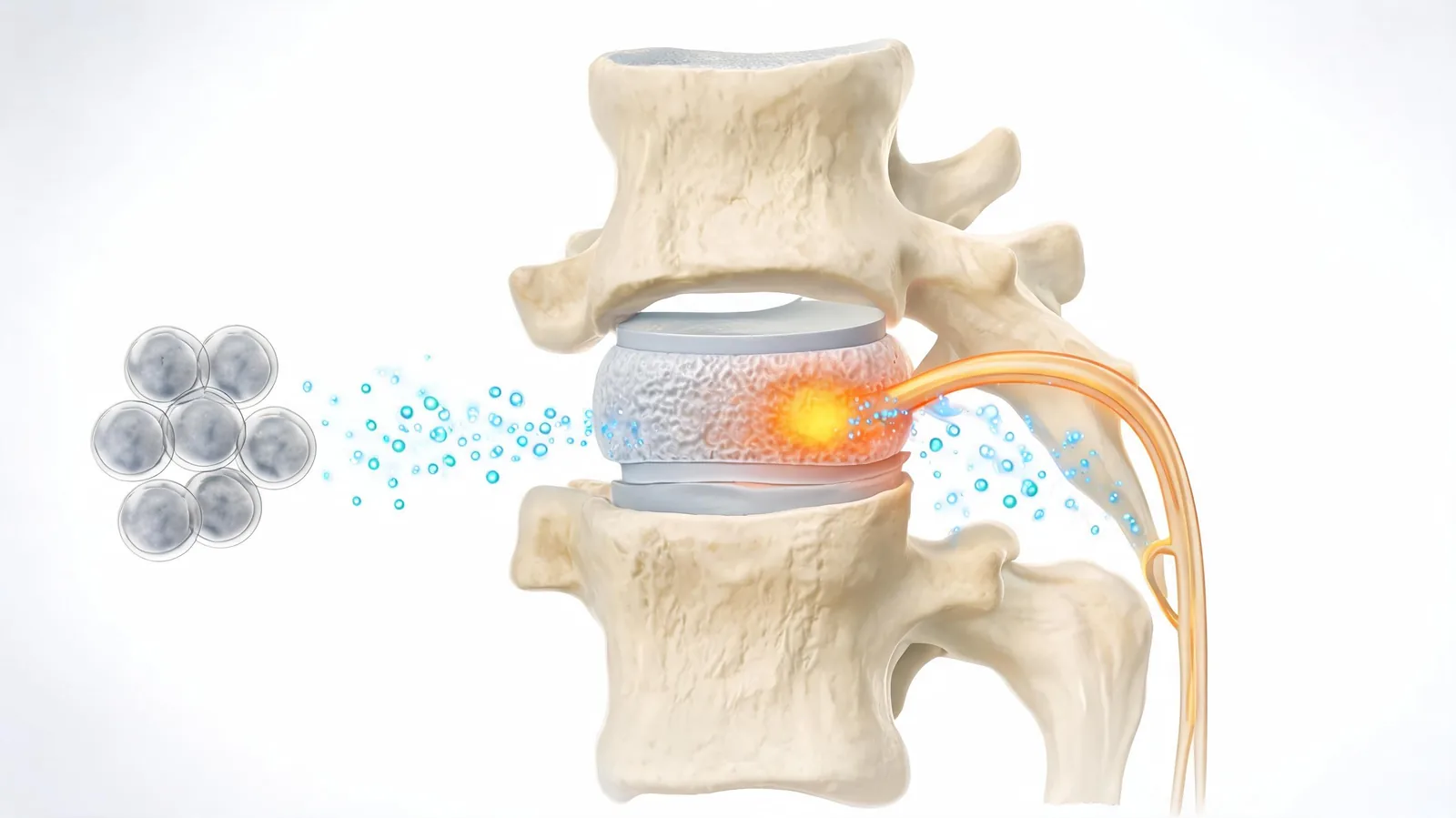
The intervertebral discs between the vertebrae act as shock-absorbing cushions. With age or repeated strain, discs lose water and their structure weakens; when the disc itself becomes a source of pain in this process, it is called discogenic or degenerative disc back pain. Discs have almost no blood vessels, so their ability to repair themselves after damage is very limited — the background to research using cells to support disc repair.
Current standard treatment
The basis of treatment for chronic low back pain is exercise therapy, physiotherapy, staying active, medicines such as analgesics and muscle relaxants, and cognitive behavioural therapy to help with understanding and coping with pain. When a specific cause is identified, injections such as nerve blocks or radiofrequency treatment are used, and spinal fusion or disc replacement may be considered for some patients. Surgery does not help everyone, however, and many patients fall between conservative care and surgery without a suitable option. Stem cell research aims to test whether it could fill this middle ground.
Why stem cells are studied
One hypothesis is that mesenchymal stem or precursor cells injected directly into a degenerated disc might, through the factors they secrete, reduce inflammation within the disc, help disc cells rebuild matrix (the material that makes up the disc), and reduce stimulation of pain-generating nerve fibres. Studies injecting cells into the knee joint for osteoarthritis have been carried out on a similar hypothesis.
Reported research findings
Randomised, placebo-controlled study in degenerative disc back pain (2021) — 100 patients with chronic low back pain from disc degeneration lasting more than six months and not responding to conservative care were randomised to injection of allogeneic mesenchymal precursor cells into the disc at different doses or to control groups. Over 36 months of follow-up, a trend towards improved pain and disability scores and less need for further procedures or surgery was reported in some of the cell groups. Results varied by time point and subgroup, and a larger phase 3 study followed. The study was published in the Spine Journal.
Knee joint pain — a Korean phase I/II study (2014) reported improved pain and function scores in the high-dose group after injecting adipose-derived mesenchymal stem cells into the knees of patients with osteoarthritis. Details are on the knee page of the 'Spine & Joints' field.
Considerations when interpreting pain research
- Large placebo effects — because pain is assessed subjectively, considerable improvement often appears in groups receiving placebo or a sham procedure; placebo effects are known to be larger for invasive treatments such as injections and procedures.
- Natural fluctuation — chronic pain gets better and worse over time, and if treatment starts when pain is at its worst, it may naturally appear to ease afterwards.
- Concurrent treatment — exercise therapy or medication changes can affect results.
Safety and open questions
Injection into the disc carries risks of infection (discitis) and nerve injury, so sterile technique and image guidance are essential. Serious adverse events were reported to be uncommon in the study above. The U.S. Food and Drug Administration (FDA) urges caution, citing adverse events such as infections from unapproved stem cell interventions. The task in this field is to confirm efficacy in large randomised studies that assess function and imaging as well as pain.
How results are measured in pain research
Pain intensity is assessed with a numerical rating scale from 0 (no pain) to 10 (worst imaginable pain) or a visual analogue scale marked on a line. Back pain studies also use the Oswestry Disability Index (ODI), which asks how much pain limits daily life. Effects are often judged by the proportion of patients whose pain falls by 30% or 50% or more, and by whether the change exceeds the smallest difference patients can actually feel (the minimal clinically important difference).
Changes in painkiller use, whether further procedures or surgery were needed, and return to work and daily activities are also important outcomes. Disc studies sometimes use MRI to check changes in disc hydration and height, but changes on imaging are known not always to match changes in pain.
The above summarises results reported in published papers and public-agency materials. University and institute names are given to identify research sources, not to introduce or recommend any medical institution. Reported results do not mean the same effect for everyone, and the suitability of any treatment is decided by the medical team.
Regulation & Other (Crohn's, Pain, etc.) →
References
- Amirdelfan K, Bae H, McJunkin T, et al. Allogeneic mesenchymal precursor cells treatment for chronic low back pain associated with degenerative disc disease: a prospective randomized, placebo-controlled 36-month study of safety and efficacy. Spine J. 2021;21(2):212-230. View on PubMed
- Jo CH, Lee YG, Shin WH, et al. Intra-articular injection of mesenchymal stem cells for the treatment of osteoarthritis of the knee: a proof-of-concept clinical trial. Stem Cells. 2014;32(5):1254-1266. View on PubMed
- U.S. Food and Drug Administration. FDA Warns About Stem Cell Therapies (Consumer Update). https://www.fda.gov/consumers/consumer-updates/fda-warns-about-stem-cell-therapies
FTH Co., Ltd. (FTH) is not a medical institution. We provide overseas medical information guidance and translation and interpretation support for medical materials, and does not provide medical consultation, diagnosis, treatment or medical judgements.