The following is general information introducing research findings. Results reported in studies do not mean the same outcome for any individual, and most of these studies are small or early-stage.
Summary — A leading example of stem cell research in stroke is the team at Sapporo Medical University in Japan. In a study giving intravenous mesenchymal stem cells taken from patients' own bone marrow and expanded in their own serum (2011, 12 patients), changes in neurological scores and imaging were reported. In the United States, a phase 1/2 study giving allogeneic mesenchymal stem cells to 36 patients with chronic stroke (2019) reported changes in functional scales. Meanwhile, a randomised phase 2 study using a different cell type (MASTERS, 2017) did not meet its primary outcome.
What is ischaemic stroke?
Ischaemic stroke occurs when a blood vessel in the brain is blocked, for example by a clot, and the brain tissue it supplies is damaged; it is the most common type of stroke. Depending on the area affected, it can cause weakness of one side of the body, sensory loss, difficulty speaking or understanding speech, visual field loss and swallowing problems. Brain cells begin to be damaged within a short time once blood flow stops, so how quickly treatment is received strongly affects recovery.
Damaged brain cells rarely recover, but considerable recovery can occur as remaining networks reorganise to take over functions (neuroplasticity). Recovery is usually most active in the first months and slows afterwards. Stem cell studies are therefore designed differently depending on whether they target the acute phase (just after onset), the subacute phase (weeks to months) or the chronic phase (after several months).
Current standard treatment
In the acute phase, reopening the blocked vessel is key: clot-dissolving medication within a set time window, or endovascular treatment that removes the clot with a catheter. Afterwards, antiplatelet or anticoagulant medication, management of blood pressure, diabetes and cholesterol, and rehabilitation — physiotherapy, occupational therapy and speech therapy — are central to recovery. Yet many people are left with long-term after-effects even after these treatments, which is why ways to further support recovery have been studied.
Why stem cells are studied
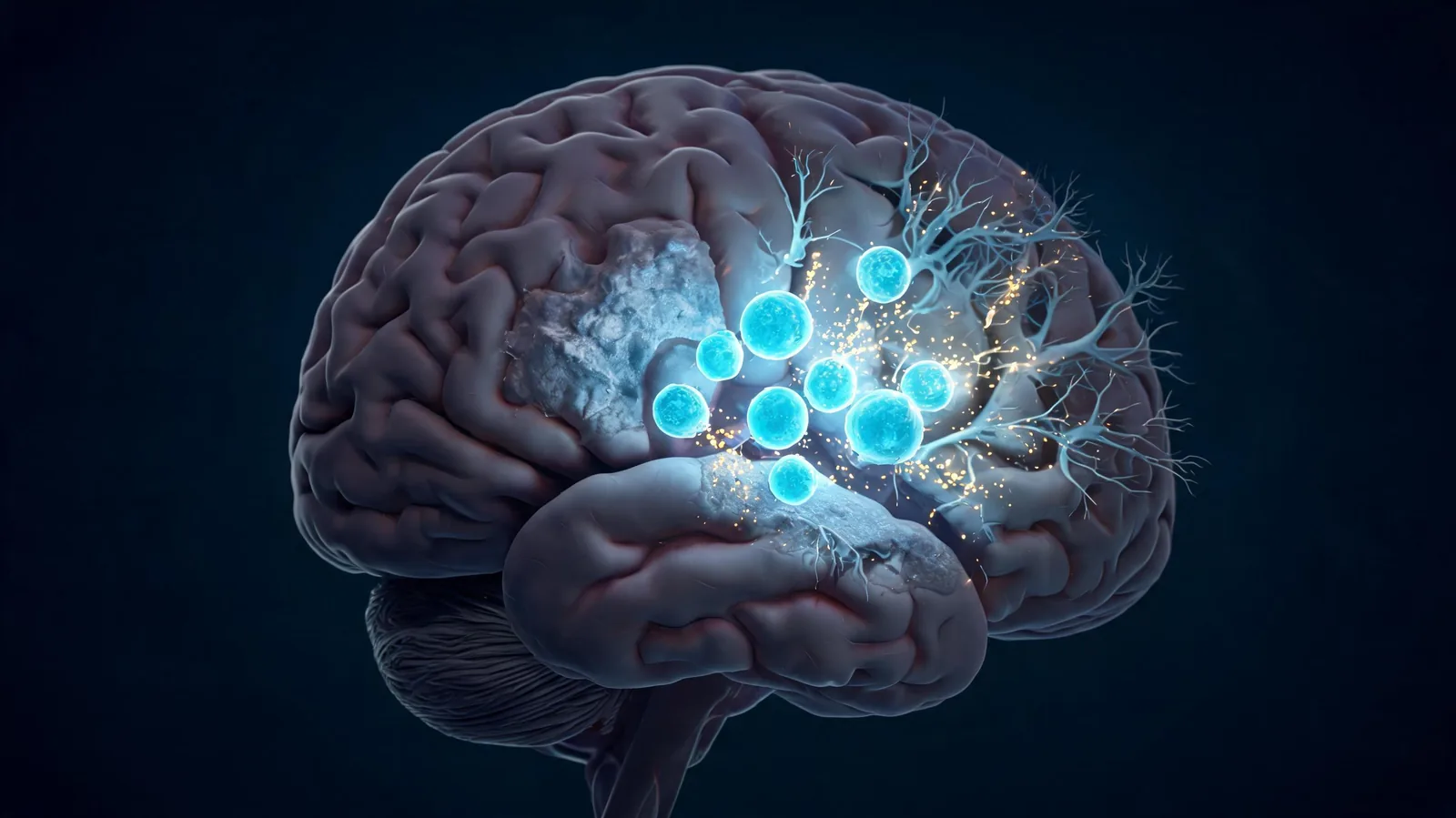
In stroke research, mesenchymal stem cells are expected not so much to replace damaged brain cells directly as to act indirectly through the factors they secrete: reducing inflammation, supporting new blood vessel formation, protecting surviving neurons and promoting network reorganisation. Animal studies have repeatedly reported that intravenous mesenchymal stem cells reduced the size of damaged areas and supported functional recovery. Whether intravenously given cells cross the blood–brain barrier (BBB) to reach the brain directly, or act at a distance through secreted factors, is still being studied.
Reported research findings
① Intravenous mesenchymal stem cells expanded in autologous serum (Sapporo Medical University, Japan, 2011) — the team obtained mesenchymal stem cells from the bone marrow of 12 stroke patients, expanded them using the patient's own serum instead of bovine serum, and gave a single intravenous infusion. Using the patient's own serum is intended to reduce the risk of infection or immune reactions from animal-derived components. After infusion, the rate of improvement in neurological deficit scores (NIHSS) increased, and a reduction in lesion volume on MRI was observed in the first week after infusion. The study was published in the journal Brain, and the same technology later led to a conditionally approved product for spinal cord injury in Japan. However, it was a small study without a control group, making it hard to separate the effects of spontaneous recovery and rehabilitation.
② Allogeneic mesenchymal stem cell phase 1/2 study (United States, 2019) — 36 patients with chronic stroke, more than six months after onset, received a single intravenous infusion of donor mesenchymal stem cells. The main aim was safety, and serious infusion-related adverse events were reported to be uncommon. Over 12 months, improvements were reported in functional scales such as neurological deficit scores and the Barthel index of daily living. It attracted attention because spontaneous recovery is limited in the chronic phase, but it was also a single-arm study without a control group.
③ MASTERS randomised, double-blind phase 2 (2017) — patients with acute ischaemic stroke received multipotent adult progenitor cells (MAPC) intravenously within 24–48 hours of onset, compared with placebo. No major safety problems were reported, but there was no significant difference from placebo on the primary outcome, functional recovery at 90 days. The investigators presented an exploratory finding that patients treated earlier after onset showed a better trend.
What has been reported about safety
In these studies, intravenous mesenchymal stem cells or progenitor cells were generally well tolerated, and serious adverse events directly related to infusion were reported to be uncommon. A review of the clinical use of mesenchymal stromal cells also concludes that the short-term safety of intravenous administration has been fairly consistently confirmed, while listing quality differences arising from manufacturing methods and how to measure potency as challenges.
Open questions
Key questions for stem cell research in stroke are when to give cells, which cells, and how many. The next step is to confirm results reported in small studies in randomised studies with control groups, and such studies are continuing in several countries, including Japan.
How results are measured in stroke research
Stroke studies measure neurological deficits with the National Institutes of Health Stroke Scale (NIHSS), which scores consciousness, gaze, visual fields, facial and limb strength, sensation and language from 0 to 42. Independence in daily life is assessed with the modified Rankin Scale (mRS), from 0 (no symptoms) to 6 (death), and the Barthel index, covering 10 items such as eating, moving and dressing; in large studies the mRS at 90 days is commonly the primary outcome.
The above summarises results reported in published papers and public-agency materials. University and institute names are given to identify research sources, not to introduce or recommend any medical institution. Reported results do not mean the same effect for everyone, and the suitability of any treatment is decided by the medical team.
Brain Disorders (Stroke, Parkinson's, Dementia, ALS, MS) →
References
- Honmou O, Houkin K, Matsunaga T, et al. Intravenous administration of auto serum-expanded autologous mesenchymal stem cells in stroke. Brain. 2011;134(Pt 6):1790-1807. View on PubMed
- Levy ML, Crawford JR, Dib N, et al. Phase I/II study of safety and preliminary efficacy of intravenous allogeneic mesenchymal stem cells in chronic stroke. Stroke. 2019;50(10):2835-2841. View on PubMed
- Hess DC, Wechsler LR, Clark WM, et al. Safety and efficacy of multipotent adult progenitor cells in acute ischaemic stroke (MASTERS): a randomised, double-blind, placebo-controlled, phase 2 trial. Lancet Neurol. 2017;16(5):360-368. View on PubMed
- Galipeau J, Sensébé L. Mesenchymal stromal cells: clinical challenges and therapeutic opportunities. Cell Stem Cell. 2018;22(6):824-833. View on PubMed
FTH Co., Ltd. (FTH) is not a medical institution. We provide overseas medical information guidance and translation and interpretation support for medical materials, and does not provide medical consultation, diagnosis, treatment or medical judgements.