The following is general information introducing research findings. Results reported in studies do not mean the same outcome for any individual, and most of these studies are small or early-stage.
Summary — Acute myocardial infarction is one of the earliest and most extensively studied areas of stem cell research. In the randomised, double-blind REPAIR-AMI study (Germany and others, 2006), patients given bone marrow-derived cells into the coronary artery showed a greater improvement in left ventricular ejection fraction at four months than the placebo group. The later European BAMI study (2020), designed to test for a reduction in mortality, had fewer events than expected because standard care performed well, did not reach its planned size, and could not confirm a difference in mortality.
What is myocardial infarction?
Myocardial infarction (heart attack) occurs when a coronary artery supplying the heart muscle is suddenly blocked by a clot and the muscle it supplies is damaged. Most result from rupture of a fatty plaque in an artery narrowed by atherosclerosis, which triggers a clot. Severe, crushing chest pain is the typical symptom, often with cold sweat, breathlessness and nausea. Hypertension, diabetes, high cholesterol, smoking and family history are major risk factors.
Heart muscle deprived of blood suffers irreversible damage over time and is eventually replaced by scar tissue. If the damaged area is large, pumping function declines and heart failure can follow — hence the saying 'time is muscle'.
Current standard treatment
The key treatment is reopening the blocked artery as quickly as possible. Percutaneous coronary intervention, which widens the blockage with a catheter and places a stent, is standard, and clot-dissolving drugs are used in some situations. Afterwards, antiplatelet drugs, statins, beta-blockers and renin–angiotensin system inhibitors prevent recurrence and heart failure, together with cardiac rehabilitation and risk factor management. With these advances, survival after acute myocardial infarction has improved greatly over recent decades.
Why stem cells were studied
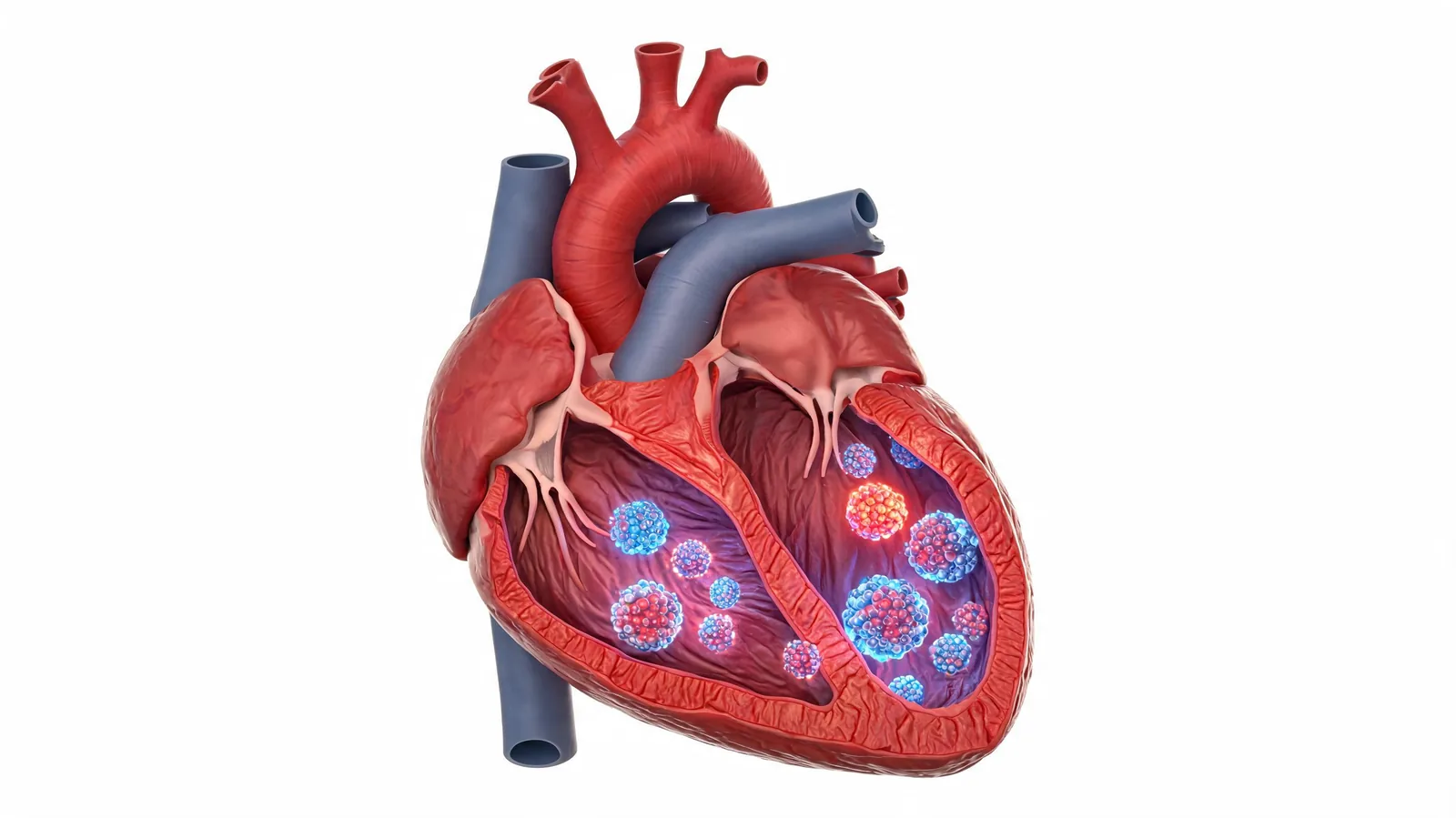
Reopening the artery does not restore heart muscle that has already been damaged, so from the early 2000s researchers began giving cells soon after the event to support recovery and reduce scarring. The typical approach separates mononuclear cells (including haematopoietic stem cells and various progenitors) from the patient's own bone marrow and infuses them directly into the reopened coronary artery. The main hypothesis was that factors secreted by the cells would promote new blood vessels and modulate inflammation, protecting the heart muscle.
Reported research findings
① REPAIR-AMI randomised, double-blind study (Germany and others, 2006) — about 200 patients with acute myocardial infarction who had successful coronary intervention received their own bone marrow-derived cells or placebo into the coronary artery a few days later. At four months, the improvement in left ventricular ejection fraction was significantly greater in the cell group than in the placebo group, especially in patients with lower ejection fraction at the start. At one year, fewer combined events of death, recurrent heart attack and repeat revascularisation were reported in the cell group. Published in NEJM, the study attracted great attention.
② BAMI (Europe, 2020) — planned with several thousand patients across European countries to determine whether effects reported in studies such as REPAIR-AMI translated into lower mortality. However, because standard care performed well, deaths were far fewer than expected, recruitment was difficult, and only part of the planned number took part. As a result, no statistically significant difference in mortality could be confirmed, and the investigators stated the study was too small to reach a conclusion.
③ Related research — in ischaemic cardiomyopathy developing in the chronic phase after a heart attack, the POSEIDON study (2012), which injected mesenchymal stem cells directly into the heart wall, reported a reduction in scar size. This is covered in detail on the heart failure page.
What the results mean
Early randomised studies reported improvements in heart function measures, but pooled across studies the improvements were modest and results varied between studies. Standard care has also advanced so much that proving additional benefit now requires very large studies. For these reasons, cell therapy is not currently used as standard care for acute myocardial infarction, and studies in patients most likely to benefit — such as those with extensive damage — remain an open task.
What has been reported about safety
Infusion of bone marrow cells into the coronary artery was generally performed safely in these studies, and serious complications directly related to the procedure were reported to be uncommon. The burden of bone marrow collection and an additional catheter procedure is also considered.
How results are measured in myocardial infarction research
The most commonly used measure in cell therapy studies after myocardial infarction is left ventricular ejection fraction (LVEF), the percentage of blood in the left ventricle pumped out with each contraction. It is measured by echocardiography or cardiac MRI; cardiac MRI can also precisely measure the extent of damaged heart muscle (infarct size) and the amount of scar tissue. REPAIR-AMI used the change in ejection fraction at four months as its primary outcome.
Whether improvements in imaging measures such as ejection fraction or infarct size translate into outcomes that matter to patients must be confirmed separately. Studies like BAMI are therefore needed that use mortality, or major adverse cardiovascular events (MACE) combining death, recurrent heart attack and heart failure hospitalisation, as outcomes. Differences in such outcomes can be confirmed only when enough events accumulate, so the better standard care becomes, the more patients are needed.
The above summarises results reported in published papers and public-agency materials. University and institute names are given to identify research sources, not to introduce or recommend any medical institution. Reported results do not mean the same effect for everyone, and the suitability of any treatment is decided by the medical team.
References
- Schächinger V, Erbs S, Elsässer A, et al. Intracoronary bone marrow-derived progenitor cells in acute myocardial infarction. N Engl J Med. 2006;355(12):1210-1221. View on PubMed
- Mathur A, Fernández-Avilés F, Bartunek J, et al. The effect of intracoronary infusion of bone marrow-derived mononuclear cells on all-cause mortality in acute myocardial infarction: the BAMI trial. Eur Heart J. 2020;41(38):3702-3710. View on PubMed
- Hare JM, Fishman JE, Gerstenblith G, et al. Comparison of allogeneic vs autologous bone marrow-derived mesenchymal stem cells delivered by transendocardial injection in patients with ischemic cardiomyopathy: the POSEIDON randomized trial. JAMA. 2012;308(22):2369-2379. View on PubMed
FTH Co., Ltd. (FTH) is not a medical institution. We provide overseas medical information guidance and translation and interpretation support for medical materials, and does not provide medical consultation, diagnosis, treatment or medical judgements.