The following is general information introducing research findings. Results reported in studies do not mean the same outcome for any individual, and most of these studies are small or early-stage.
Summary — Research on exosomes for ovarian aging produced encouraging human results in 2026. In a randomized pilot trial run by a fertility research team in Caracas, Venezuela, with researchers from the University of Kentucky (USA) and Marconi University (Italy), immature eggs from 32 women aged 38–46 with diminished ovarian reserve were cultured with exosomes taken from each woman's own blood. The maturation rate reached 63.63%, compared with 11.53% in standard culture medium. The results were published in the journal Bioengineering on 29 July 2026. In September 2026, a Czech gynecology journal published a study in which 29 women who had obtained no eggs in earlier IVF cycles received their own fat-derived stem cells into the ovaries; their AMH, a marker of ovarian function, rose. This article summarizes these two studies from overseas journals in the past six months, along with Japan's policy discussion on exosomes.
Ovarian aging and diminished ovarian reserve — what is the problem?
A woman is born with all the primordial follicles that will supply her eggs for life, and both their number and quality decline with age. This is called ovarian aging, and having fewer remaining follicles than others of the same age is called diminished ovarian reserve (卵巣予備能低下 in Japanese). When ovarian function falls sharply before age 40, it is classified separately as premature ovarian insufficiency (POI).
Ovarian reserve is estimated from blood anti-Müllerian hormone (AMH) and follicle-stimulating hormone (FSH), and from the antral follicle count seen on ultrasound. The standard path is to stimulate follicle growth, retrieve eggs and perform in vitro fertilization (IVF) or intracytoplasmic sperm injection (ICSI). With low reserve, however, few eggs are retrieved, and some of them often remain at an immature stage that cannot be fertilized. Researchers are therefore studying both ways to bring immature eggs to full maturity and ways to restore the ovarian environment itself. The broader picture of stem cell research in female infertility is on our female infertility stem cell information page.
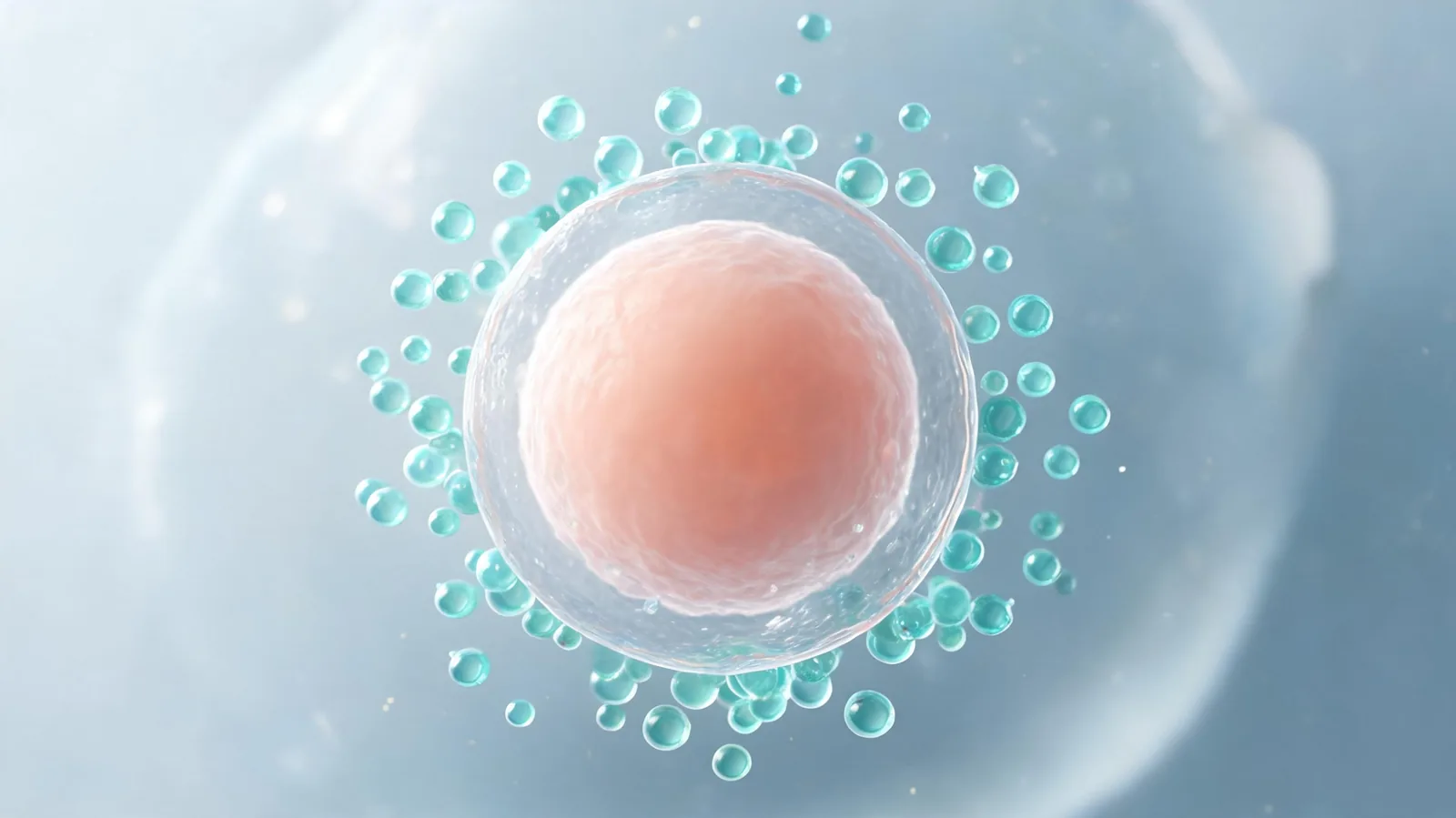
Randomized trial of exosomes for ovarian aging — more immature eggs matured
Exosomes are tiny sacs released by cells. They carry signaling molecules such as proteins and microRNAs to neighboring cells. The team reasoned that in women with diminished ovarian reserve these signals are weaker inside the follicle, so eggs grow less well, and tested whether exosomes could supply the missing signals.
Between January 2023 and January 2025, the team screened 57 women with AMH below 1 ng/mL and 3 to 6 antral follicles per ovary, enrolled 32, and randomly assigned 16 to each group. The mean age was 42.16 years. All underwent the same ovarian stimulation, yielding 111 eggs (52 mature and 59 immature); only the immature eggs were used in the experiment. One group's eggs were cultured for 24 to 36 hours in standard in vitro maturation medium, and the other's in the same medium with 10 µg of exosomes added. The exosomes were autologous: platelet-rich plasma was collected from each patient's blood and filtered with an ultrafiltration device.
The main outcome, the egg maturation rate, was 63.63% in the exosome group and 11.53% in the standard culture group (P<0.001). The fertilization rate of matured eggs was also higher in the exosome group, at 76.19% versus 33.33%. In the exosome group, 12 embryos met the criteria for freezing on day 3, and 75% of that group's embryos met the predefined morphological criteria. After statistical adjustment for multiple eggs coming from the same woman, exosome culture remained strongly associated with egg maturation (odds ratio 15.46). As planned for this phase, no embryos were transferred and they were stored instead; the team is preparing the next stage of research, including preimplantation genetic testing.
Fat-derived stem cells into the ovary in 29 women — eggs were obtained in women whose AMH rose
In 2026, the Czech gynecology journal Česká gynekologie (volume 91, issue 4) published an analysis of records from 29 women aged 25–40 with poor ovarian response who had not obtained a single egg in a previous IVF cycle. The team placed one million mesenchymal stem cells, derived from each woman's own fat tissue, into four sites of the cortex of both ovaries by laparoscopy, and two months later stimulated the ovaries again and retrieved eggs.
Median AMH rose significantly from 0.01 ng/mL to 0.02 ng/mL (P=0.001). Of the factors analyzed, the only one clearly linked to successful egg retrieval was the size of the AMH increase: the larger the rise, the higher the chance of obtaining eggs. Because these women started from very low levels, the numerical change is small, but the result matters because it reopened the chance of egg retrieval for women who previously had none. The team proposed larger prospective studies with control groups that follow outcomes through pregnancy and birth.
Study stage and how to read the results
The exosome study is a randomized pilot trial with a control group, and its distinctive feature is that the exosomes were not given to the body but were used while culturing retrieved eggs. It is therefore accurate to read it as a culture technique that makes more of the retrieved eggs usable, not as evidence that the ovary itself became younger. These exosomes also came from the patient's own blood, not from stem cells. The fat-derived stem cell study is a retrospective analysis of the same women's values before and after treatment. Both are early studies with small numbers of participants, and "an effect was reported" does not mean the same result "has been proven" for everyone. The research teams are continuing with follow-up studies in more women.
Looking at uterine research alongside these studies makes the trend clearer. Clinical results on restoring a thin endometrium with bone marrow stem cells are in our article on bone marrow stem cells for infertility, and stem cell research on aging in general is on our frailty and aging stem cell information page.
Japan is updating its rules on exosomes
In Japan, treatments that give cells to people require a plan, reviewed by a committee, to be submitted to the Ministry of Health, Labour and Welfare under the Act on the Safety of Regenerative Medicine. Exosomes and stem cell culture supernatant (conditioned medium), however, are secretions rather than cells and have so far been outside the scope of this law. According to Kyodo News, a ministry working group began discussions on 1 July 2026, as part of a review of the law, on whether to bring exosome treatments under legal regulation and on how to evaluate the validity of regenerative medicine offered as self-paid care. The aim is to refine the system so that patients can access new technologies in a setting with quality and safety standards. The history of Japan's regenerative medicine system is covered in our timeline of regenerative medicine in Japan.
Frequently asked questions
Did the ovarian aging exosome study inject exosomes into the body?
No. In the July 2026 randomized trial, exosomes from the patient's own blood were added to the culture medium while retrieved immature eggs were being cultured. Exosomes were not placed directly into the ovaries or blood vessels, so the findings are best understood as results of an in vitro maturation culture technique.
How do exosomes differ from stem cells?
Stem cells are living cells that can multiply and develop into various cell types. Exosomes are small sacs released by cells; they are not cells themselves but carry signaling molecules. Some exosomes come from stem cells, and others, like those in this study, come from blood, so it is worth checking their source.
Can women with very low AMH take part in stem cell research?
Participants in the fat-derived stem cell study had a very low median AMH of 0.01 ng/mL. However, each study sets its own eligibility conditions, such as age, hormone levels and previous treatment history. Whether an approach suits an individual is judged by the treating medical team based on ovarian and overall health.
Summary
In 2026, overseas journals published a series of human studies using exosomes and fat-derived stem cells to make the most of eggs in women with low ovarian reserve affected by ovarian aging. Autologous exosomes markedly raised the maturation rate of immature eggs, and women who had obtained no eggs before showed a rise in AMH and had eggs retrieved again. In Japan, policy discussions have begun on handling exosomes safely. For families hoping for a child, ovarian aging research is steadily widening the concrete options. The suitability and risks of any treatment are judged by the treating medical team.
This content summarizes published scientific papers and news reports. Names of universities and research institutions are given to identify research sources and do not introduce or recommend any medical institution. Suitability for treatment is judged by the treating medical team.
References
- Navarro Arrieta CT, Zavos PM, Aragona C, Saleem SAMA, Bezerra Espinola MS, Navarro VA. Use of Autologous Exosomes to Enhance Oocyte Maturation in Patients with Diminished Ovarian Reserve: A Prospective, Randomized Clinical Trial (Pilot Study). Bioengineering (Basel). 2026;13(8):875 (published 2026-07-29). doi:10.3390/bioengineering13080875 https://doi.org/10.3390/bioengineering13080875
- Çolakoğlu MC, Horasanlı JE, Akkuş F. Do adipose-derived mesenchymal stem cells improve reproductive potential in patients with inadequate ovarian response? Ceska Gynekol. 2026;91(4):290-298 (PubMed 2026-09-07). doi:10.48095/cccg2026290 View on PubMed
- 共同通信. 「エクソソーム」治療の規制検討 再生医療安全確保法見直し. 2026-07-01. https://ryukyushimpo.jp/kyodo/entry-5357591.html
FTH Co., Ltd. (FTH) is not a medical institution. We provide overseas medical information guidance and translation and interpretation support for medical materials, and does not provide medical consultation, diagnosis, treatment or medical judgements.