The following is general information introducing research findings. Results reported in studies do not mean the same outcome for any individual, and most of these studies are small or early-stage.
Summary — In autumn 2026, diabetes stem cell research brought encouraging results in patients. A team at the Third Affiliated Hospital of Sun Yat-sen University in Guangzhou, China, reported on 30 September in Signal Transduction and Targeted Therapy a randomised, double-blind, placebo-controlled phase 1 trial in which mesenchymal stem cells taken from gum tissue (GMSCs) were given intravenously to people with type 1 diabetes. In 5 of the 9 people who received the cells (55.6%), C-peptide, a marker of the body's own insulin production, rose, and daily insulin use fell. Taipei Medical University analysed 107 mesenchymal stem cell trials in diabetes, and Zhejiang Chinese Medical University reviewed progress in stem cell-derived islet transplantation.
Why is type 1 diabetes a major target of stem cell research?
Type 1 diabetes is an autoimmune disease in which the immune system attacks the beta cells in the pancreatic islets of Langerhans, so almost no insulin is made. People with it manage blood glucose with insulin injections or a pump for life. Continuous glucose monitors and automated insulin delivery help a great deal, but few treatments slow the loss of beta cells itself.
Stem cell research is moving in two directions. One uses the immune-regulating ability of mesenchymal stem cells to protect the beta cells that remain. The other grows insulin-producing islet cells from stem cells and transplants them. The principles and history of both are summarised on our diabetes stem cell research page.
How the gum stem cell phase 1 trial was run
The trial was led by the Department of Endocrinology and Metabolism at the Third Affiliated Hospital of Sun Yat-sen University, with the hospital's stomatology department and cell and gene therapy researchers at the Songjiang Institute in Shanghai. It enrolled people aged 18 to 60 with type 1 diabetes diagnosed within the previous ten years. Between March 2022 and May 2023, 23 people were screened and 18 were randomised, 9 to each group. Their average age was 31.4 years.
The stem cell group received gingiva-derived mesenchymal stem cells at 1 million cells per kilogram of body weight, by intravenous injection four times at three-week intervals (weeks 0, 3, 6 and 9). The placebo group received an identical-looking placebo, and neither patients nor doctors knew who received which. Both groups continued their usual insulin treatment and were followed for 48 weeks. All 18 participants completed the trial.

C-peptide rose and insulin use fell
The primary endpoint was beta-cell function at week 12, measured by C-peptide over two hours after a mixed-meal drink. At week 12, the stem cell group showed increases in the C-peptide area under the curve, fasting C-peptide and peak C-peptide, and the differences from the placebo group were statistically significant. Beta-cell function rose in 5 of the 9 people given stem cells (55.6%). In the placebo group, C-peptide stayed below the detection limit throughout.
Insulin use also changed for the better. Daily insulin doses in the stem cell group fell after the first injection and stayed below baseline for all 48 weeks. Despite using less insulin, fasting glucose, post-meal glucose and HbA1c were controlled as well as in the placebo group. Notably, one participant stopped insulin after the first injection and kept good glucose control through the rest of the treatment period. The team plans to follow this person to learn what sets them apart from other participants.
Safety and how it may work
Over 48 weeks, hypoglycaemia was no more frequent in one group than the other. Some participants had mild events such as headache, cramps, facial swelling or sleep problems, which settled without treatment. There were no serious adverse events, and no one left the trial because of an adverse event.
Blood analyses showed a rise in the proportion of "exhausted" CD8-positive T cells, the less active form of the cells that attack beta cells. The researchers suggest that gum stem cells tire out aggressive T cells and so reduce damage to beta cells. Gum tissue is also attractive because it can be collected with little burden during dental care. Stem cells from teeth are also covered in our article on baby-tooth stem cells in cerebral palsy.
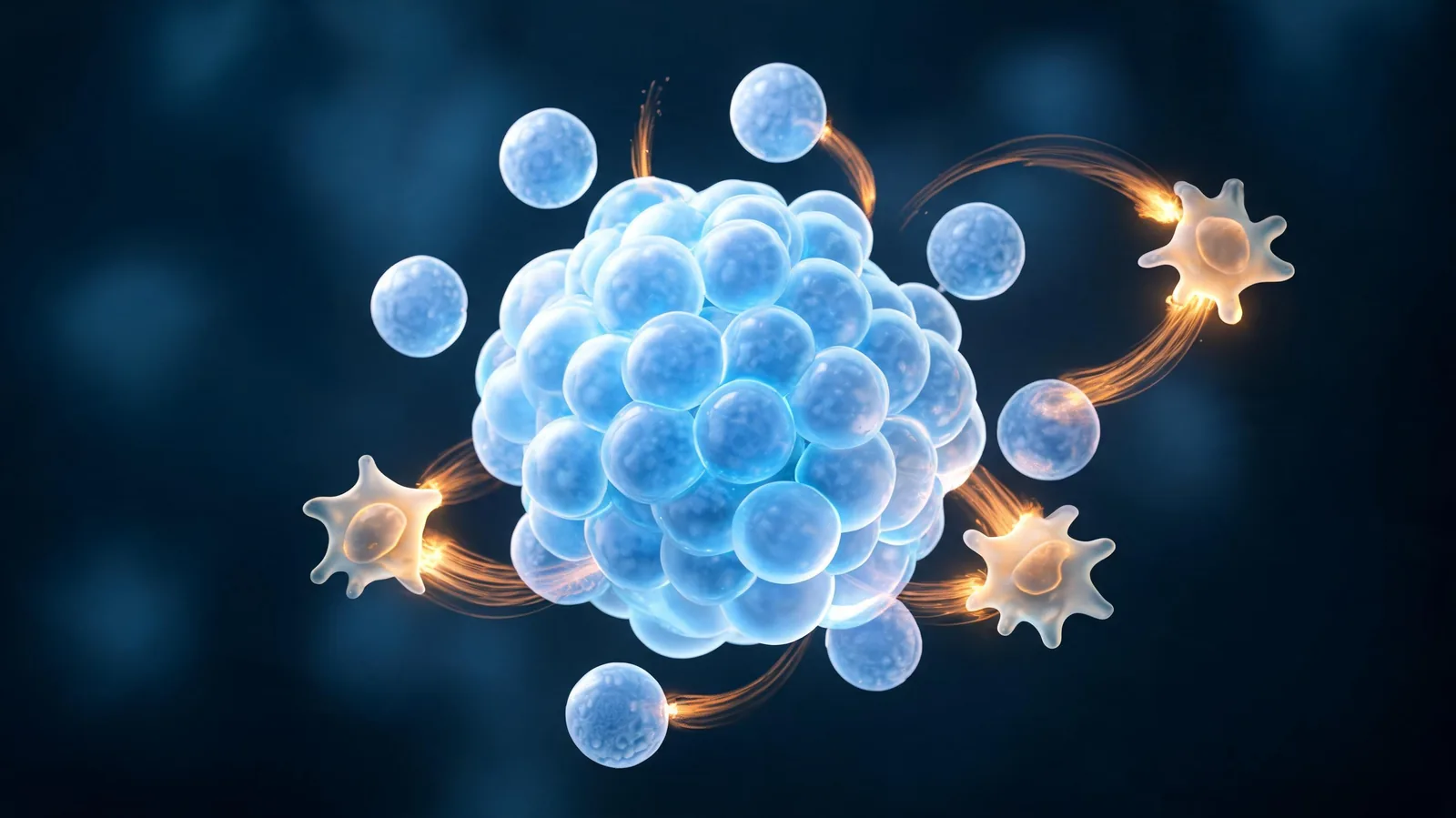
107 diabetes stem cell trials and the progress of islet transplantation
In August 2026, a Taipei Medical University team published in Metabolism an analysis of 107 registered mesenchymal stem cell trials in diabetes, covering type 1 and type 2 diabetes and a range of complications. Early trials mostly used patients' own bone marrow or fat-derived cells; more recent ones increasingly use standardised umbilical cord-derived mesenchymal stem cells and cell-free derivatives such as exosomes. The most consistent benefits were reported in blood-flow and wound-healing complications, especially diabetic foot ulcers. The authors concluded that mesenchymal stem cell therapy shows promise as a safe and potentially disease-modifying add-on treatment.
In October, a Zhejiang Chinese Medical University team published a review of beta-cell replacement in Frontiers in Endocrinology. It reports that in the phase 1/2 trial of a stem cell-derived islet product (zimislecel, formerly VX-880), all 14 people followed for over a year had detectable C-peptide, and 10 of the 12 who received the full dose were insulin-independent on day 365. One person who received islets made from their own iPS cells was insulin-free from day 75 through one year. In August 2026 the developer, Vertex, said enrolment and dosing in the phase 1/2/3 zimislecel trial were continuing.
Research stage and next steps
The gum stem cell trial is an 18-person phase 1 study, an early stage whose first aim is safety. It is meaningful that rising C-peptide and lower insulin use were reported under a rigorous randomised, double-blind, placebo-controlled design. The team says longer and larger studies are needed to confirm long-term safety and benefit. Mesenchymal stem cell research continues in other organs too; for the liver, see our liver cirrhosis stem cell article.
Frequently asked questions
Can diabetes stem cell treatment let people stop insulin?
In this gum stem cell phase 1 trial, 1 of 9 participants stopped insulin, and the others continued insulin at lower doses. In stem cell-derived islet trials, many participants were reported to live without insulin injections. Results can differ from person to person.
What does C-peptide tell us?
C-peptide is released together with insulin when the body's own beta cells make it. Injected insulin contains none, so a rise in C-peptide is read as a sign that the patient's own pancreas is producing more insulin.
Is type 2 diabetes also studied with stem cells?
According to the Taipei Medical University analysis, many mesenchymal stem cell trials have been registered for type 2 diabetes and complications such as diabetic foot. Consistent results were reported particularly for diabetic foot. Eligibility is set separately for each trial.
Conclusion
In diabetes stem cell research, gum-derived mesenchymal stem cells raised C-peptide and lowered insulin use in a randomised, placebo-controlled phase 1 trial, and stem cell-derived islet transplantation is adding more cases of life without insulin. Progress on both immune regulation and beta-cell replacement is encouraging news for people with type 1 diabetes and their families. Reported results do not mean the same effect for every patient. The suitability and risks of any treatment are decided by the medical team.
References
- Tang Q, Zhou L, Fan L, Zhang W, Tang X, Zeng D, et al. Safety and efficacy of human gingiva-derived mesenchymal stem cells in patients with type 1 diabetes: a double-blind, randomized, placebo-controlled, phase 1 trial. Signal Transduct Target Ther. 2026;11. doi:10.1038/s41392-026-03021-8 (published 2026-09-30) View on PubMed
- Jhuang HY, Lee JY, Wang LT. Mesenchymal stem cell therapy for diabetes: clinical evidence, emerging strategies, and future perspectives. Metabolism. 2026;184:156748. doi:10.1016/j.metabol.2026.156748 (published 2026-08-18) View on PubMed
- Chen L, Hu X, Zheng C, Huang Q, Xu J, You X, Wang C. Beta-cell replacement for type 1 diabetes: integrating cell products, engraftment and immune protection. Front Endocrinol. 2026;17:1981945. doi:10.3389/fendo.2026.1981945 (published 2026-10-05) https://www.frontiersin.org/journals/endocrinology/articles/10.3389/fendo.2026.1981945/full
- Vertex Pharmaceuticals. Vertex Reports Second Quarter 2026 Financial Results. 2026-08-04. https://crisprmedicinenews.com/press-release-service/card/vertex-reports-second-quarter-2026-financial-results/
FTH Co., Ltd. (FTH) is not a medical institution. We provide overseas medical information guidance and translation and interpretation support for medical materials, and does not provide medical consultation, diagnosis, treatment or medical judgements.